


Natural marble and stone doors represent the pinnacle of architectural luxury. For centuries, stone has been the definitive material of fortresses, palaces, and cathedrals. Today, when interior designers and high-net-worth clients seek an entrance that conveys permanence and prestige, they return to these ancient materials. However, applying natural stone to a modern security door—which must be dynamic, lightweight, and mechanically reliable—is a feat of advanced material science.
In high-end projects across North America, the challenge is clear: how do you capture the “timeless grandeur” of stone without the impractical weight and fragility that usually accompanies it?
1. The Engineering of Weight Distribution
The primary constraint of using natural marble and stone doors is mass. A solid slab of stone is too heavy for standard hinge systems, and its lack of flex can lead to cracking during the thermal expansion cycles of a building.
To achieve this look, we utilize “sandwich panel” construction. The stone is cut into ultra-thin veneers (typically 3mm to 6mm) and laminated onto a high-strength composite substrate—often carbon fiber or aircraft-grade aluminum honeycomb. This preserves the visual authenticity of the stone while reducing the dead weight of the door by up to 80%. This engineering approach ensures that the door operates with the “featherlight” precision required for luxury entryways.
2. Book-Matching for Aesthetic Impact
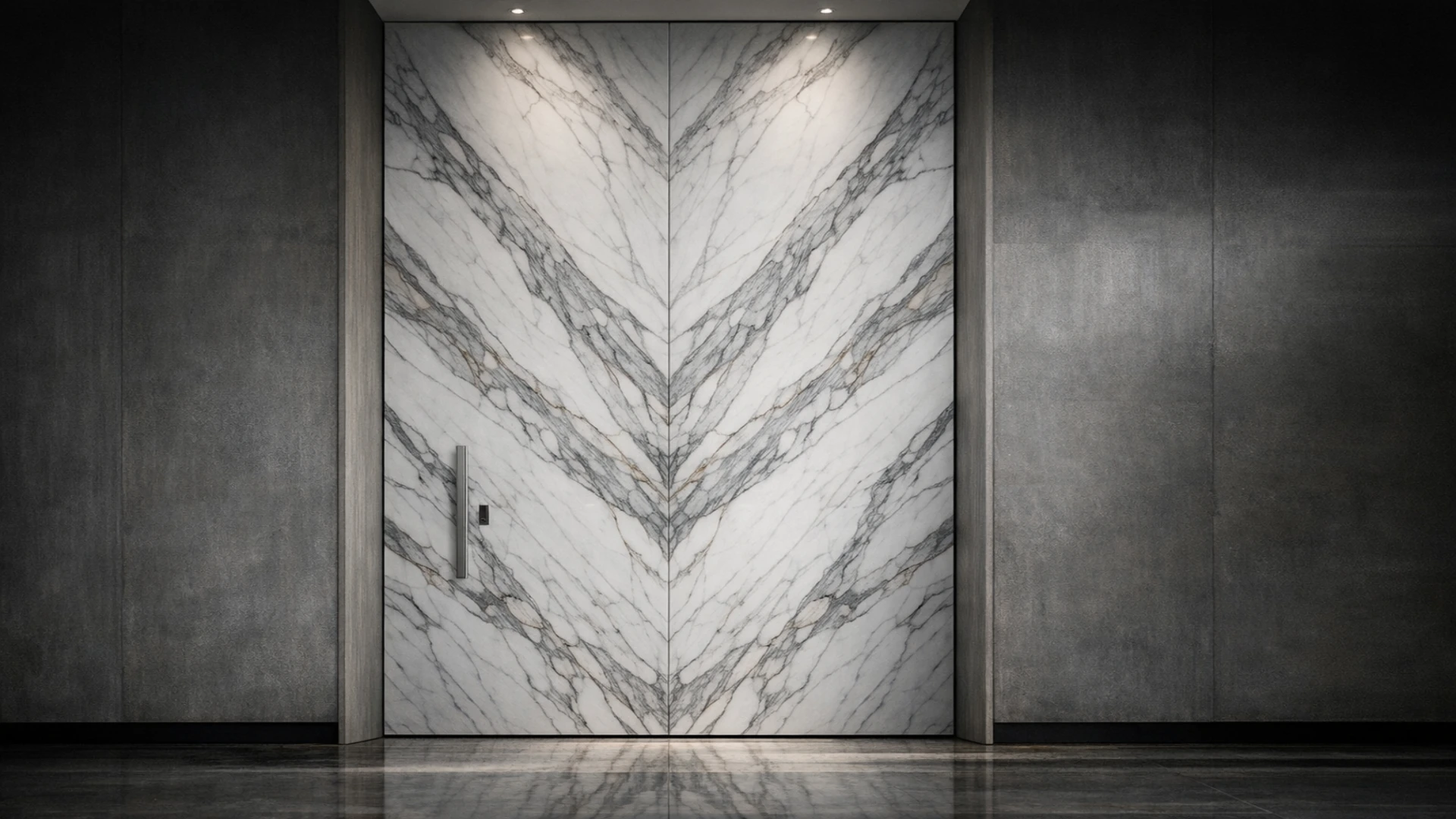
For detail-oriented clients, the “wow factor” of marble is rarely found in the stone itself, but in how it is presented. Book-matching—where two adjacent slabs of stone are mirror-imaged—is essential for natural marble and stone doors.
This technique creates a large-scale, symmetrical pattern that transforms a standard door into a singular art piece. When specifying stone for entry systems, designers must work closely with the fabricator to select the block before cutting, ensuring the veins align perfectly across the door leaf and the surrounding frame.
3. Selecting the Right Stone for Longevity
Not all stone is equal when applied to an exterior security door. Environmental exposure requires stone with high density and low porosity.
- Travertine and Limestone: Popular for their earthy textures but highly porous. They require deep-penetration sealing to prevent staining and freeze-thaw damage.
- Granite and Quartzite: The “performance” stones. They offer extreme hardness and resistance to abrasion, making them ideal for high-traffic, exterior-facing entryways.
- Marble: The “prestige” choice. While softer and more prone to etching, it offers an unmatched aesthetic depth. For exterior applications, we recommend honed or leathered finishes, which are more forgiving than polished surfaces.
4. The “Invisible Security” Integration
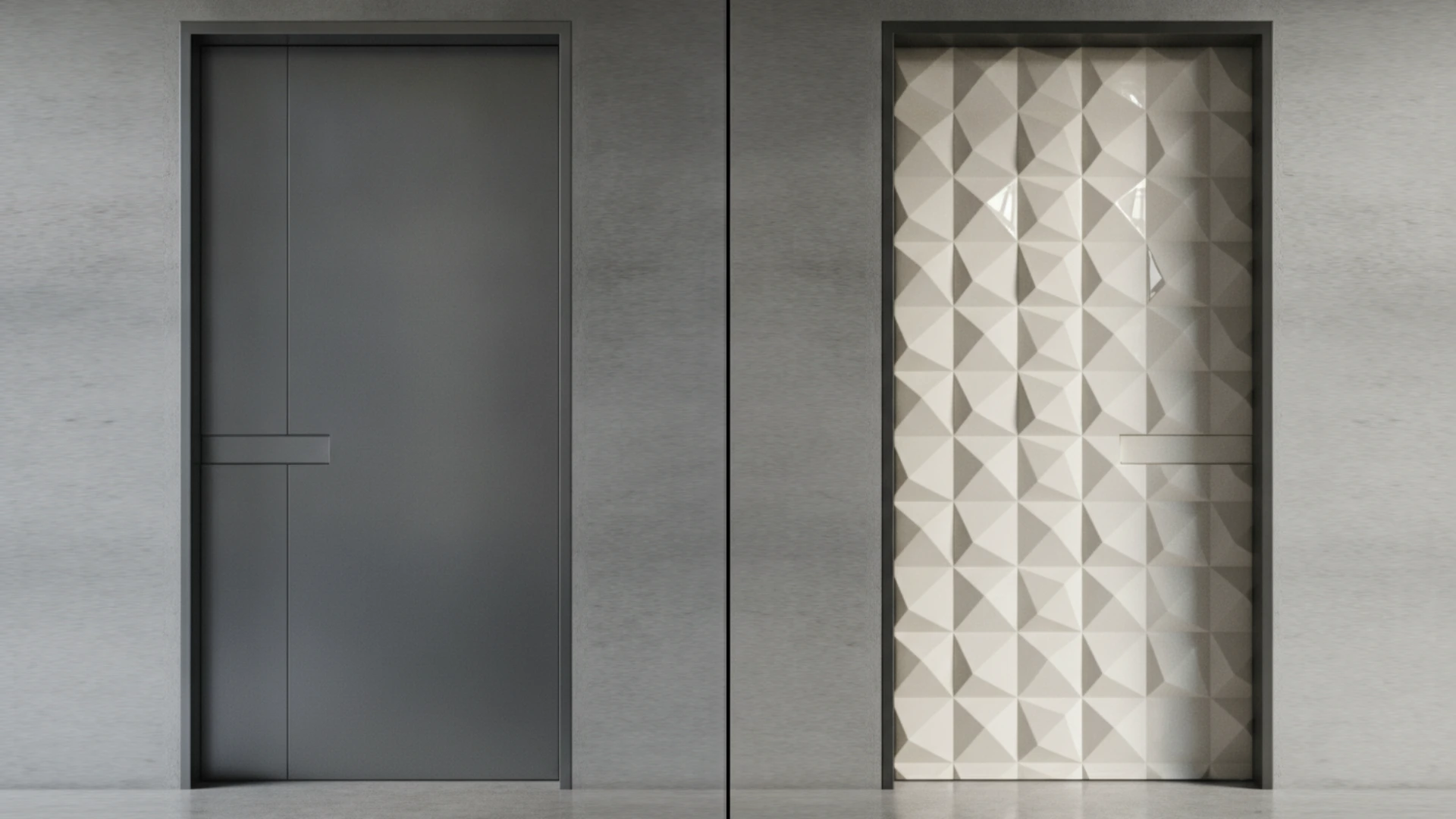
A stone-clad door must never look like a security door. The beauty of natural marble and stone doors is in their perceived solidity. This requires meticulous hardware concealment.
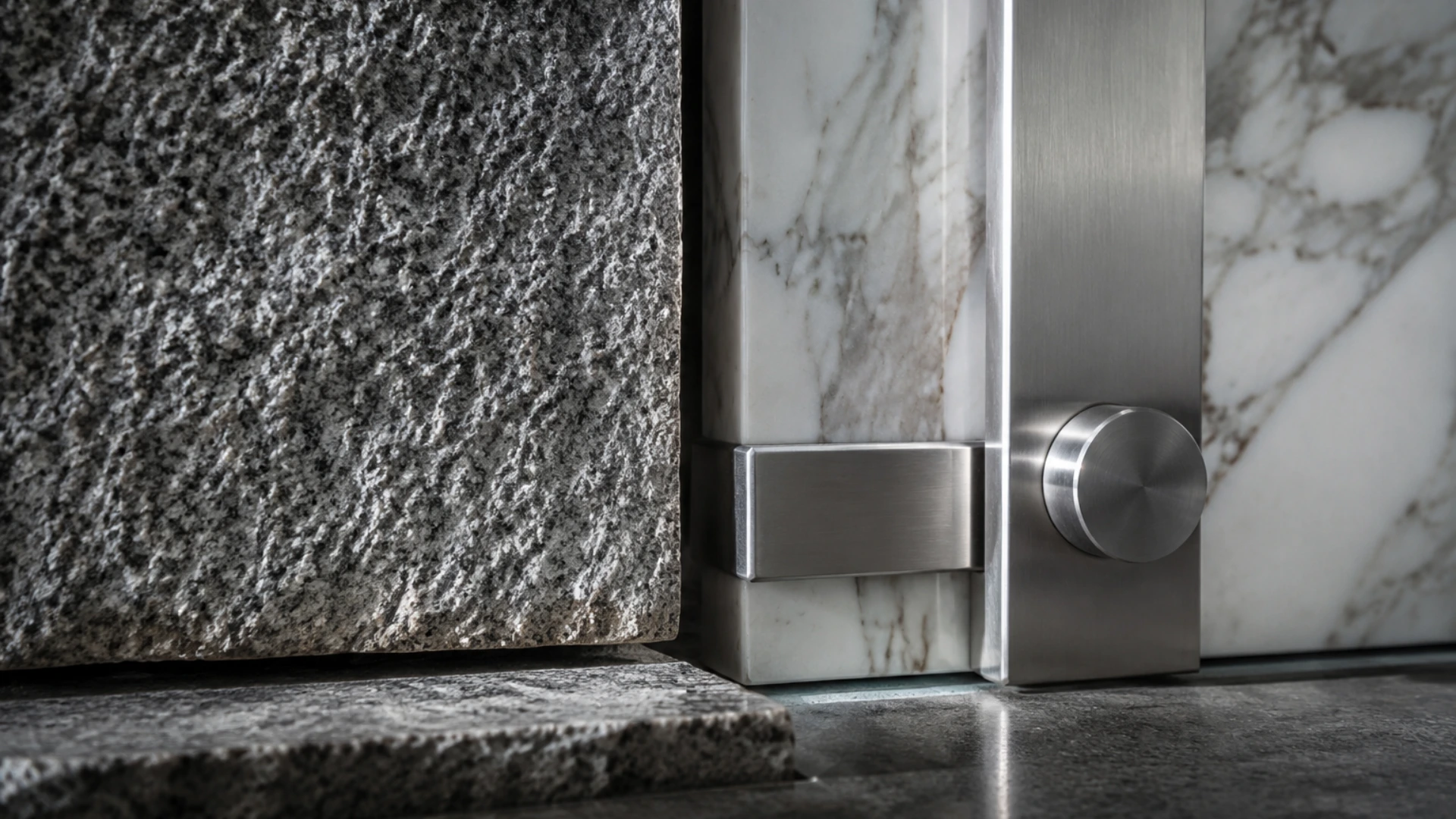
The security components—multi-point locks, reinforced steel cores, and impact-resistant strike plates—must be precision-milled into the substrate before the stone is applied. The result is a seamless stone face that hides a sophisticated, hardened security core. This “invisible defense” is the hallmark of modern elite residential design.
5. Maintenance and the Patina of Time
Unlike synthetic materials, stone lives. It interacts with the elements. For clients who appreciate the “Timeless Grandeur” of their home, this is a feature, not a bug.
However, designers must set expectations. Natural stone will weather. It may develop a subtle patina depending on the orientation of the entrance. Utilizing high-performance, breathable sealants can mitigate moisture absorption, but the stone will still age gracefully. This natural evolution is exactly what gives a home its sense of history and architectural gravity.
Conclusion
Integrating natural marble and stone doors into your project is an investment in architectural legacy. By leveraging modern composite engineering, architects can now deliver the heavy, permanent aesthetic of ancient stone on doors that operate with 21st-century mechanical precision.
If you are exploring the technical feasibility of stone-clad entrances for your next high-security project, contact our engineering team to discuss substrate compatibility and weight load calculations. For further inspiration, review our previous work with 3D porcelain cladding and Italian leather entry systems.
